What are OntoSkills?
OntoSkills are a neuro-symbolic skill platform for deterministic agents. They turn SKILL.md sources into validated OWL 2 ontologies, serve compiled skills through a local MCP runtime, and distribute published packages through OntoStore.
Why OntoSkills?
The determinism problem
LLMs read skills probabilistically. Same query, different results. Long skill files are expensive for large models and confusing for small ones.
- Non-deterministic reading — LLMs interpret text differently each time
- Token waste — Large models burn tokens parsing long documentation
- Small model limits — Complex skills are unreadable by edge models
- No verifiable structure — Relationships between skills are implicit
The ontological solution
OntoSkills transforms skills into formal ontologies with Description Logics (OWL 2):
- Deterministic queries — SPARQL returns exact answers, every time
- Entailment reasoning — Infer dependencies, conflicts, capabilities
- Democratized intelligence — Small models query what large models read
- Formal semantics — No ambiguity in skill relationships
Performance comparison
| Operation | Reading Files | Ontology Query |
|---|---|---|
| Find skill by intent | O(n) text scan | O(1) indexed lookup |
| Check dependencies | Parse each file | Follow dependsOn edges |
| Detect conflicts | Compare all pairs | Single SPARQL query |
For 100 skills: ~500KB text scan → ~1KB query
How it works
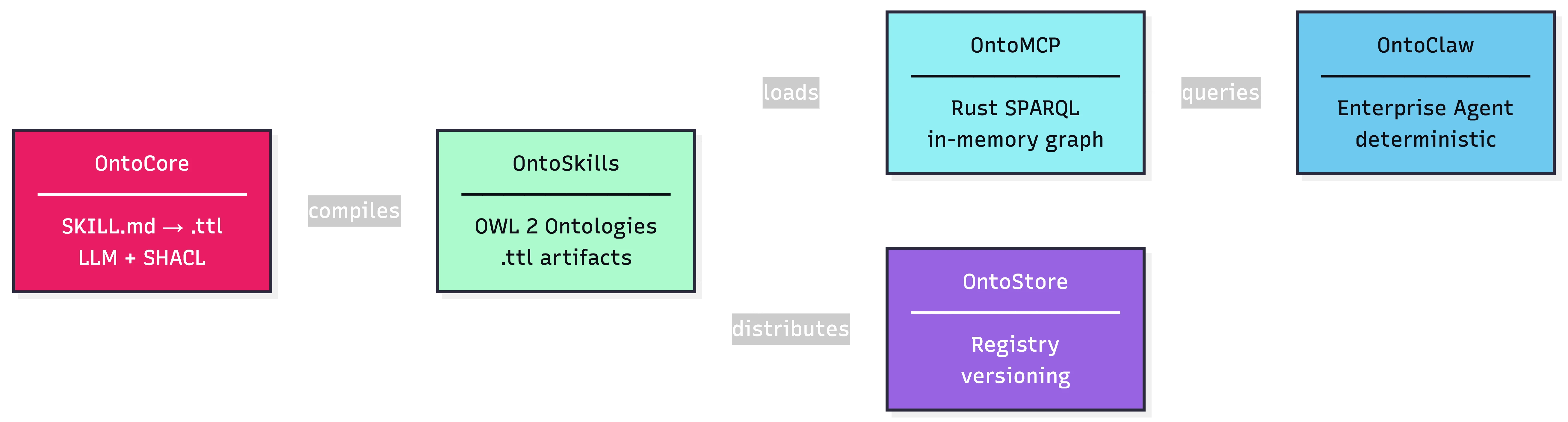
The compilation pipeline
- Extract — Claude reads SKILL.md and extracts structured knowledge
- Validate — Security pipeline checks for malicious content
- Serialize — Pydantic models → RDF triples
- Verify — SHACL gatekeeper ensures logical validity
- Write — Compiled
.ttlfiles toontoskills/
The runtime
- OntoMCP loads compiled
.ttlfiles fromontoskills/ - Agents query via SPARQL through the MCP protocol
- OntoStore is built in by default
- Third-party stores can be added explicitly with
store add-source
Key capabilities
| Capability | Description |
|---|---|
| LLM Extraction | Claude extracts structured knowledge from SKILL.md files |
| Knowledge Architecture | Follows the “A is a B that C” definition pattern (genus + differentia) |
| Knowledge Nodes | 10-dimensional epistemic taxonomy (Heuristic, AntiPattern, PreFlightCheck, etc.) |
| OWL 2 Serialization | Outputs valid OWL 2 ontologies in RDF/Turtle format |
| SHACL Validation | Constitutional gatekeeper ensures logical validity before write |
| State Machines | Skills can define preconditions, postconditions, and failure handlers |
| Security Pipeline | Defense-in-depth: regex patterns + LLM review for malicious content |
| Static Linting | Detects dead states, circular deps, duplicate intents |
| Drift Detection | Semantic diff between ontology versions |
What gets compiled
Every skill is extracted with:
- Identity:
nature,genus,differentia(Knowledge Architecture) - Intents: What user intentions this skill resolves
- Requirements: Dependencies (EnvVar, Tool, Hardware, API, Knowledge)
- Knowledge Nodes: Epistemic knowledge (8-12 nodes per skill)
- Execution Payload: Optional code to execute
- State Transitions:
requiresState,yieldsState,handlesFailure - Provenance:
generatedByattestation (LLM model used)
Components
| Component | Language | Description |
|---|---|---|
| ontoskills | CLI | User-facing installer and manager |
| OntoCore | Python | Skill compiler for SKILL.md sources |
| OntoMCP | Rust | MCP server with 5 semantic tools (incl. search_intents) |
| OntoStore | GitHub repo | Official compiled skill store |
skills/ | Markdown | Human-authored source skills |
ontoskills/ | Turtle | Compiled ontology artifacts |
Use cases
| Use Case | How OntoSkills Help |
|---|---|
| Enterprise AI Agents | Deterministic skill selection via SPARQL queries |
| Edge Deployment | Smaller models query large skill ecosystems |
| Multi-Agent Systems | Shared ontology as coordination layer |
| Compliance & Audit | Every skill carries attestation and content hash |
| Skill Marketplaces | OntoStore and third-party stores enable plug-and-play distribution |
Next steps
- Getting Started — Install and compile your first skill
- CLI — Learn the managed command surface
- OntoStore — Browse installable store skills
- OntoCore — Install compiler for custom skills
- Store — Learn how official and third-party stores work
- Architecture — Deep dive into the system design
- Knowledge Extraction — Understanding knowledge nodes
- Troubleshooting — Fix common install and runtime issues
- Roadmap — See what’s coming next